People
Places
Events
Clubs
Courses
Resources
Accomplishments
Memories
And Traditions

that couldn’t exist anywhere else
People
Places
Events
Clubs
Courses
Resources
Accomplishments
Memories
And Traditions
that couldn’t exist anywhere else
Anyone who has walked these halls, taken courses here or taught them, or worked to keep the college running knows that FIT defies categorization. We are part of the State University of New York (SUNY) and also globally renowned, with students hailing from more than 65 countries. Yes, we teach fashion design—but also business and science and film and much, much more. Some consider us a commuter school, yet we house 2,300 students in our four residence halls. We have a world-class museum plus thousands of square feet of other gallery space for rotating exhibitions. Our students might take seven or eight classes while holding down an internship and a job. We have a robust athletics program! We are a leader in sustainability education! We offer more than 40 minors!
Maybe we need to stop trying to define FIT—an impossible task!—and celebrate the myriad delights of all kinds that create a college experience unlike any other in the world. So here are 50 things about FIT that make us smile. Our list is hardly comprehensive. Tell us what’s “so FIT” to you at [email protected].

FIT Hives started as a project for Clinton Global Initiative University, in which college students from all over the country proposed changemaking ideas and made them happen. The hives have been used as a teaching tool ever since.

The garden, on the ninth floor balcony, grows 31 species of plants, 25 of which can be used as natural dyes: sunflowers, coreopsis, marigolds, and many more. Almost 200 students participated in garden activities last year: gardening, harvesting, participating in a dye workshop.
Whitney Crutchfield, the assistant professor of Textile Development and Marketing who oversees the garden, guides research about the viability of natural dyes in industry. So far, only boutique lines and capsule collections have been dyed naturally, she says. “We are starting to quantify it. I’m always astounded by how much we can achieve when we work together.”

Thanks to the work of science professors Theanne Schiros, Evelyn Rynkiewicz, and Karen Pearson, as well as Preeti Arya (Textile Development and Marketing), Susanne Goetz (Textile/Surface Design), and Asta Skocir (Fashion Design)—among others!—FIT has become a leader in the development of biomaterials, regenerative and biodegradable fibers and textiles that could replace traditional and petroleum-based materials. Keel Labs and Werewool are two thriving biomaterials startups that began as student team projects in the annual Biodesign Challenge. Who will be next?

FIT’s sustainability ambassador is supermodel, actress, and activist Amber Valletta. She contributes to the college’s sustainability events, including the Sustainable Business and Design Conference, and helps fundraise to support innovation on campus, both programming and capital projects. She also inspires students with her warm presence and positive attitude.
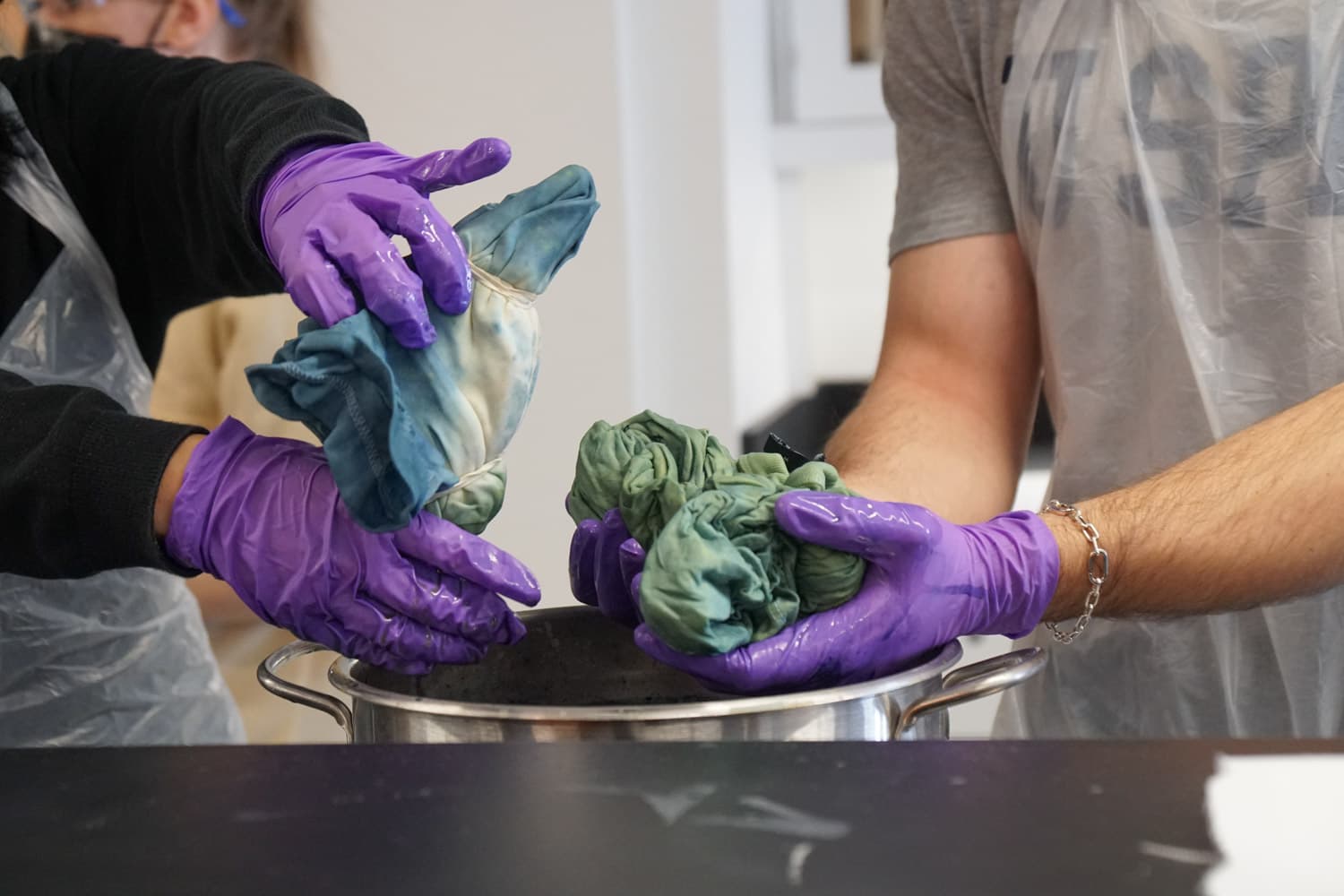
FIT’s annual Sustainable Business and Design Conference turns 20 in 2026. When the conference started in 2007, thanks to the efforts of passionate faculty members, it was geared toward the FIT community; now it draws students from area colleges and industry professionals.
“We are the only campus with a conference that focuses on the intersection between business, design, and sustainability for the fashion and creative industries,” says Karen Pearson, chair of Science and Math and chair of the Sustainability Council.
The 2026 conference, themed “Industry Disruptors,” will take place April 8 and 9.

Sustainability Awareness Week began in 2013, when Pearson and now-retired faculty member Lawrence Langham teamed up to bring small-group education and hands-on workshops to students. Typical fare includes upcycling workshops and a farmer’s market and sustainability fair on the Breezeway.
The college offers two minors in sustainability, as well. Ethics and Sustainability draws on the fields of philosophy and ecology to help students understand and critically assess environmental issues in diverse fields. Sustainable Materials and Technology teaches the science of climate change and the biology and chemistry needed to develop solutions.